
South Houston, TX · Garage Door Service
Garage Door Spring Repair Around South Houston
Torsion and extension spring failures are common in South Houston's 1980s-era housing stock. Here's what goes wrong, why, and when to call instead of fix it yourself.
- Repairs & new doors
- Springs & openers
- Serving 4 nearby communities
What Can Go Wrong
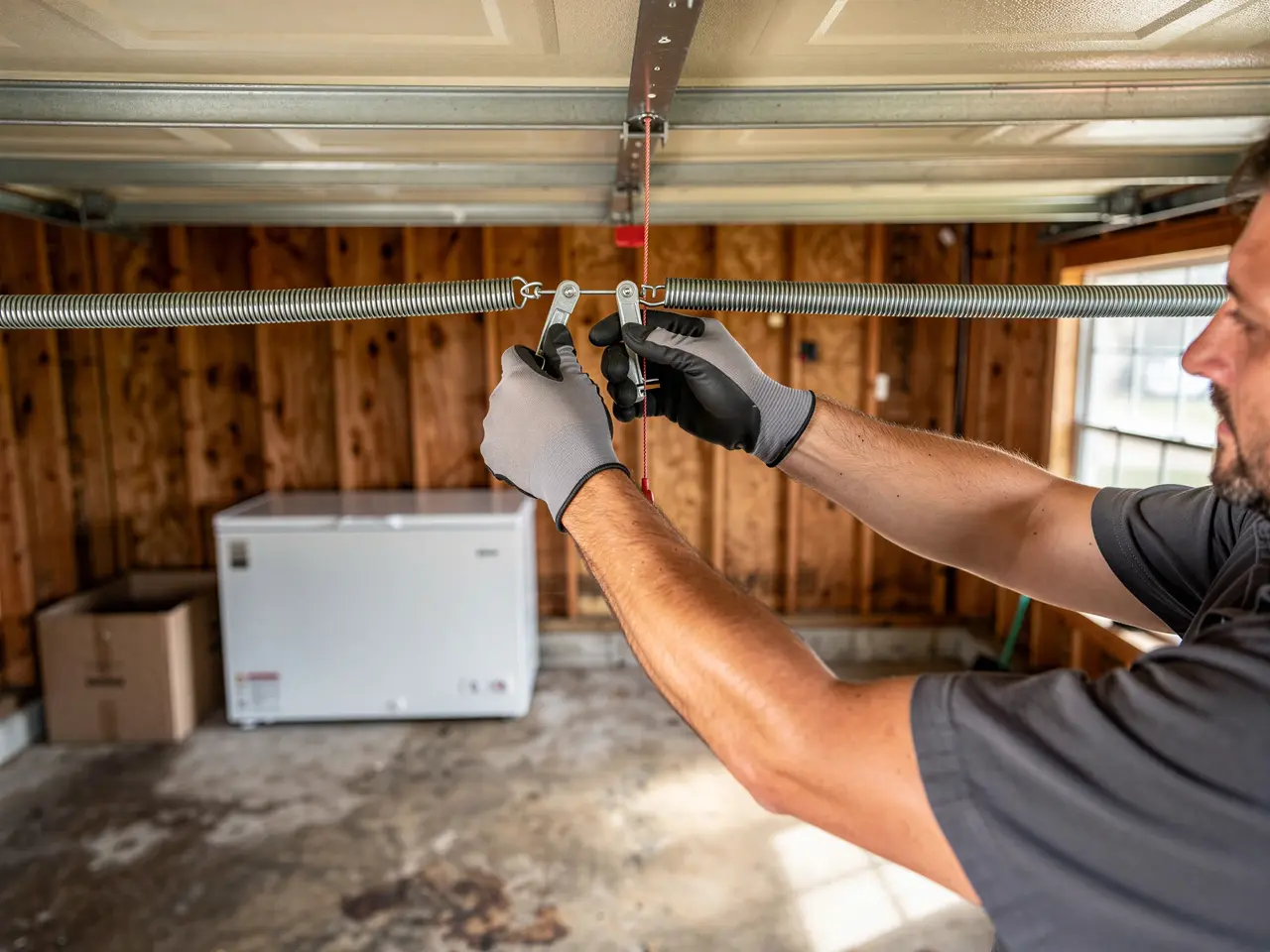
A garage door spring does one job: it carries the weight of the door so the opener and your arm don't have to. When it fails, it fails in one of a few predictable ways. A torsion spring (the kind wound on a shaft above the door) can snap clean, usually with a bang loud enough to bring someone running. An extension spring (stretched along the horizontal tracks) tends to go slower, stretching out, losing tension, or breaking a cable end that was never rated for the repeated cycling.
Either way, the door stops behaving the way it should. A double door that two people used to lift without thinking now won't budge, or it slams down fast because there's nothing left holding it up. Sometimes only one spring on a two-spring torsion setup lets go, and the door goes sideways instead of lifting square, which stresses the tracks and rollers on top of the original problem.
We see this across the service area on both torsion and extension setups, often on doors that were never upgraded since the house was built. The fix itself is usually straightforward for someone who works on these every day, but the parts have to match the door's weight and the drum size has to match the shaft, or the new spring fails again in months, not years.
What Causes It Around Here
Housing across this service area was built mostly between 1956 and 2014, with the typical home dating to 1983, and the stock leans heavily toward 1980s and 90s construction across the 23 named neighborhoods we cover. That matters because a lot of those doors still have their original torsion or extension hardware, sized to codes and door weights that were standard forty years ago. Springs have a rated cycle count, somewhere around 10,000 open-and-close cycles for a standard torsion spring, and a door opened twice a day for three decades has already burned through that number more than once.
The climate here is mild with only occasional freeze, so we don't get the hard winter cold that shocks metal and snaps springs outright the way it might further north. What we get instead is slower: humidity swings that work rust into the coils a little at a time, loosening the temper of the steel without any single dramatic event. A spring can look fine on a Tuesday and let go on a Wednesday.
With 40,967 owner-occupied houses among 61,397 households in this area, there's a lot of aging single-family stock carrying original hardware, which is a big part of why spring calls are as steady as they are.
How It Shows Up
Most people notice a spring problem before it fully fails. The door gets heavier to lift by hand, or the opener starts straining and making a grinding or whining noise it didn't make before. If you watch the door move, you might see it jerk partway up, or tilt to one side as it travels, which usually means one spring on a two-spring torsion bar has already gone and the other is doing all the work.
A fully snapped torsion spring is hard to miss. There's a loud crack, sometimes loud enough that neighbors ask about it, and the door won't move at all afterward, even with the opener engaged, because the opener was never meant to lift the door's full weight on its own. An extension spring failure is quieter. The door might still open, just slower and heavier, or it drops hard on the way down because the cable or spring that used to control its descent isn't doing that job anymore.
Gap between the coils when the door is down, or a visibly stretched or separated spring along the track, is worth a look before it becomes a no-movement call. None of these signs are unique to the South Houston housing corridor, but given how much of the stock here falls in that 1980s-and-90s window, they show up often.
Doing It Yourself
A garage door spring is one of the few home repairs we'll flatly tell you not to do yourself. A torsion spring is wound under enormous tension, enough to break fingers or worse if the winding bars slip, and the tools for it aren't something most households own. Extension springs are lower-tension but still store enough energy to snap a cable and whip it across a garage.
What you can reasonably do yourself: check whether both springs on a torsion setup are intact, listen for grinding before it turns into silence, and keep the door balanced rather than forcing it if it's sticking partway. If you notice the door is noticeably harder to lift than it used to be, that's your window to get it looked at before it fails all the way, rather than after.
One honest limitation: if the door and track are also showing their age, bent rollers, rusted hinges, a header bracket pulling away, a spring swap on its own won't fix the whole system, and we'll tell you that rather than sell you a spring and send you on your way with a door that still isn't right.
Frequently asked questions
How do I know if it's the spring or the opener that's broken?
If the door won't move and the opener motor hums or clicks without lifting it, that's almost always a spring, not the opener. Openers are built to assist a balanced door, not lift its full weight. Try opening the door by hand with the opener disconnected; if it's heavy or won't budge, the spring is the problem.
Why did my spring break with no warning?
Springs rarely fail without warning, the warning is just quiet. Rust works into the coil over years of humidity swings, and the steel loses temper gradually rather than all at once. By the time it snaps, it's usually been weakening for months. Noise, stiffness, or uneven movement beforehand are the signs most people miss.
Is it worth replacing just one spring on a two-spring door?
We generally replace both at once on a two-spring torsion setup, even if only one broke. The surviving spring has typically logged the same cycle count and is close behind. Replacing one and leaving the other means a second service call within a year or two, which costs more total than doing both now.
Can I just tighten or adjust the existing spring instead of replacing it?
No. Torsion springs are adjusted by winding tension, not by tightening a fastener, and that requires the right winding bars and a clear understanding of how many quarter-turns the specific spring needs. Get it wrong and the spring or the bar can let go under load. This is not a tighten-and-done fix.
By Neighborhood
Spring Repair across the South Houston area
We also handle spring repair in these South Houston-area suburbs.
Book garage door service in South Houston
Call now or request a quote - tell us what the door is doing and where you are.